Architecture
This page describes how Kaval.AI is put together and why. It is intended for two audiences: engineers deciding whether the design fits their problem, and contributors — human or automated — who need to know where a change belongs before making it. Where a design decision has a rationale that is not evident from the code, that rationale is recorded here.
For the vocabulary of language-model applications, see Core concepts. For the persisted schema, see The database and data model. For an assessment against comparable frameworks, see How Kaval.AI compares.
The thesis
Most agent frameworks are libraries of behaviour: you call an agent, it decides what to do, and the framework’s job is to make that decision easy to express. Kaval.AI takes a different position. An agentic application is a program, and a program should have a declared structure, typed boundaries and an execution record. The framework’s job is to hold the model to that structure.
Three commitments follow from this, and nearly every design decision below is an instance of one of them.
The structure is data. A workflow is a graph, and that graph is a document — YAML in a repository, reviewed in a pull request, rendered as a diagram, served over HTTP and stored beside the runs it produced. It is not a side effect of the order in which Python statements happen to execute.
Every boundary is typed. Each value crossing a node boundary is a validated
Pydantic model. A malformed value fails at the node that produced it, not three
steps later in a dictionary lookup that returns None.
Execution is a matter of record. Every session, run, node execution and model call is written to a database the operator owns. Observability is not a subscription; it is a table.
The components
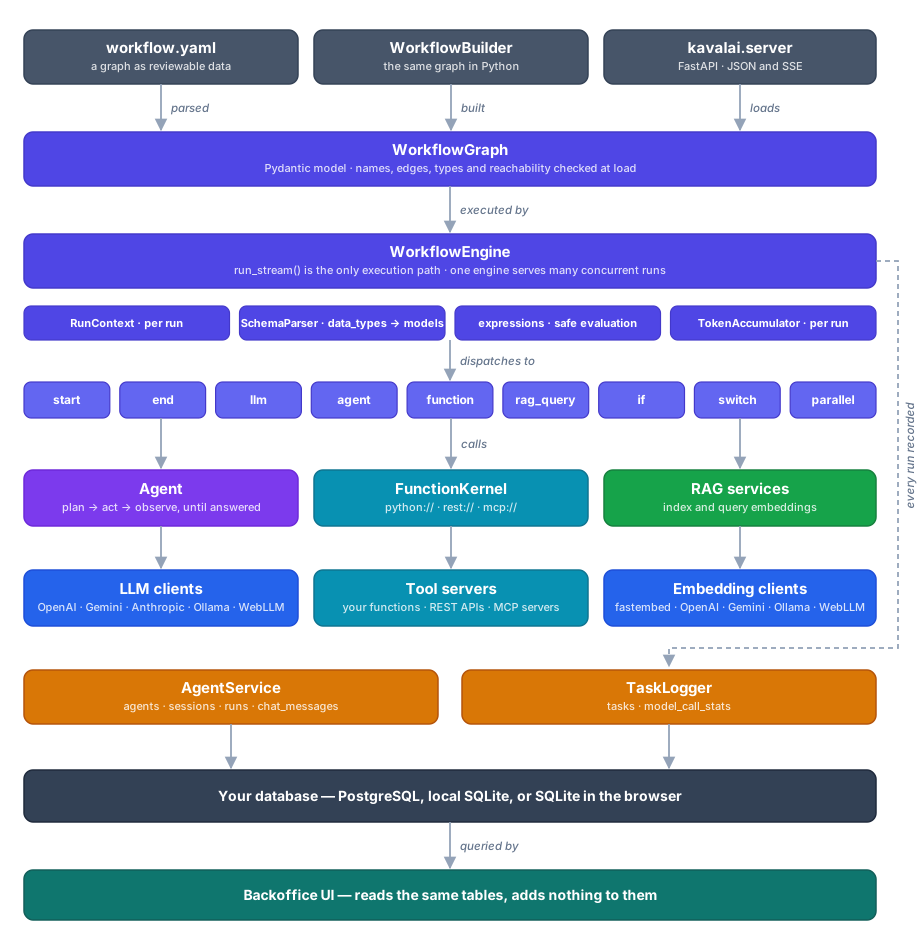
The figure reads downwards. Definition becomes a validated graph; the engine walks that graph; nodes reach outwards to models, tools and indexes; and everything that happened is recorded in a database the backoffice interface later reads. The sections below take each band in turn.
Definition: two front doors, one graph
A workflow may be written as a YAML document or assembled with
WorkflowBuilder. These are not two systems. Both produce a
WorkflowGraph, a Pydantic model, and everything downstream
sees only that graph. The consequence worth stating explicitly is that the two
front doors cannot drift apart: a feature reachable from one is reachable from
the other, because both terminate in the same model.
The graph is validated when it is loaded rather than when it runs. Loading
fails if node names collide, if there is not exactly one start node, if
there is no end node, if two end nodes return different data types, if
a transition names a node that does not exist, or if a node writes an
output not declared in data_types. Structural errors therefore surface
at deployment rather than in production, on the branch that is taken once a
month.
data_types entries are JSON-schema fragments, compiled by SchemaParser
into Pydantic models. Two names are reserved: input and output, the
types of the workflow itself. This is what allows a workflow to be served over
HTTP with a generated, accurate request and response schema without the author
writing one.
Note
Design constraint. Anything that changes the shape of a workflow belongs
in kavalai.workflow.models first. The builder, the YAML loader, the
engine, the SVG renderer and the backoffice all derive from those models;
adding a capability to the engine alone produces a feature that YAML cannot
express and the diagram cannot show.
Execution: one engine, many runs
WorkflowEngine walks the graph. Its single execution path is
run_stream(), an asynchronous generator of WorkflowStreamEvent; the
convenient run() drains it. Having one path rather than two is a
deliberate constraint, and it is why streaming behaviour cannot diverge from
non-streaming behaviour: there is no second implementation in which to
introduce the divergence.
The engine is designed to be shared. One engine may serve many concurrent runs, which requires a clear division of state:
Per-run state lives on
RunContext— the resolved data each node has seen and the token accumulator into which every model call reports. Anything scoped to a single invocation belongs here, and_branch_contextmust forward it when a run splits. The node-visit budget that terminates runaway cycles is counted per run for the same reason: were it counted per walk, each branch of aparallelnode would receive the full allowance.Engine-level state is opened once — the
FunctionKerneland its MCP sessions are established byawait engine.connect()and released byawait engine.aclose(). They are never opened or closed per run.
Both halves of that rule have been violated in this codebase before, and both
produced the same class of defect: a token accumulator shared between
concurrent runs reported one run’s usage against another, and a kernel closed
in a per-run finally block tore down MCP sessions that other runs were
still using. The division above is what prevents recurrence.
Node kinds
The walker dispatches on node type, and the set is deliberately small:
Node |
Role |
|---|---|
|
The graph’s boundary. Exactly one |
|
One structured completion. The prompt is rendered, the model is called,
and the validated result is stored under |
|
A full tool-using loop inside one node, for the case where the model should decide which tools to call. |
|
Exactly one tool call, addressed by URI, for the case where the author already knows. |
|
Routing, evaluated by a restricted expression language rather than by
|
|
Fan-out across independent branches, rejoining at a named join node. |
|
One retrieval against a RAG service, read-only. Indexing is not reachable from a document. |
The distinction between agent and function deserves emphasis, because
it is where Kaval.AI differs most visibly from agent-first frameworks.
Delegating a decision to a model is a choice with a cost — latency, tokens and
non-determinism — and the design makes that choice explicit at the node rather
than implicit in a prompt. A graph in which only two of eleven nodes are
agent nodes is a graph whose behaviour is mostly determined by its author.
Concurrency is likewise explicit. A parallel node names its branches, and
the run continues at next once every branch has arrived. The alternative —
inferring a dataflow graph from inputs and reordering independent steps
automatically — was rejected. A Kaval.AI graph is a state machine with declared
edges, so reordering a → b → c because b does not read a’s output
would silently change the order of side effects the author wrote down, and
nothing in the file would reveal that the workflow now runs concurrently.
Concurrency should be legible in the document and visible in the diagram.
Branch isolation follows from the same reasoning: each branch receives its own
RunContext seeded with a shallow copy of the parent’s data, so no branch
observes a sibling’s output while both are running, and outputs are merged only
at the join. The graph validator enforces at load time that branches are
disjoint, that no two branches write the same output variable, and that a
branch contains no end node.
Reaching outwards: models, tools and indexes
Three subsystems connect a graph to the world, and each presents a single interface over several implementations.
LLM clients. OpenAI, Gemini, Anthropic, Ollama and an in-browser WebLLM
client sit behind one asynchronous interface, selected by a provider/model
string. That set is open rather than fixed: the built-ins are entries in a
registry, and register_llm_provider() adds more under names of
your own, resolvable from YAML like any other. Structured output, streaming, retries and usage statistics are the
client’s responsibility, not the caller’s — which is what makes substituting a
provider a change of one string. Provider SDKs are imported lazily, so
import kavalai succeeds in a Pyodide environment where none of them exists.
The function kernel. Python functions, REST endpoints and MCP tools are all
registered on one FunctionKernel and addressed by a uniform
URI: protocol://[name|module].function_name(args: type) -> return_type.
Every tool has generated Pydantic argument and result models, so a tool result
that cannot satisfy its declared type raises rather than propagating unvalidated.
allowed_tools restricts what a node may see and call, and means the same
thing in YAML and in Python.
Treating REST as a first-class protocol rather than something to be wrapped is a deliberate trade. Most frameworks expect a Python function around an HTTP call; Kaval.AI registers the endpoint itself, with its own schemas, so there is no wrapper to maintain. The cost is that Kaval.AI has no catalogue of pre-tested integrations, which How Kaval.AI compares states plainly.
RAG services. BaseRagService has two implementations: PostgreSQL with
pgvector, and a single-file SQLite index. They are interchangeable because the
interface, not the storage, is the contract — which is what allows an index to
be built on a server and shipped to a browser.
The interface is generic; the implementations deliberately are not. Postgres
carries a dozen methods the interface never mentions, and that is the intended
shape — a backend should expose what its store does well. What the interface
declares comes in three tiers: six required methods, two optional ones
(count_entries and iter_entries, guarded by supports()), and two
with working defaults that a backend may override. tests/rag/test_conformance.py
runs the declared contract against every backend, so “implements the interface”
is checked rather than assumed.
Recording: the run is the artefact
Persistence is split in two, and the split is by writer rather than by table.
AgentService records what the workflow was
asked and what it answered — agents, sessions, runs and chat messages. The
TaskLogger records how it got there — per-node tasks and per-call model
statistics, written behind the run so that logging never becomes the critical
path. The LLM clients themselves emit ModelCallStat records, which is why
calls made outside a workflow are recorded too. Within a run, every call — the
query embedding of a rag_query node included — reports to the run’s token
accumulator, so each model_call_stats row carries the agent, session and
run that made it.
Recording is the default, and recording less is an explicit choice. A task
logger built with record_payloads=False keeps timings and token counts but
not the prompts and answers, and an engine built with record_context=False
keeps a run’s input and output but not every node’s data. The options exist
because a model call’s request is the whole prompt — history and retrieved
passages included — which is a second copy of the conversation that a deployer
bound by data-protection rules may not be allowed to keep.
Both write to a database the operator supplies. There is no hosted collector, and the backoffice interface is a reader of those tables rather than a privileged component: it adds nothing the tables do not already contain. The schema, and the reasoning behind each table, is documented in The database and data model.
Portability: the same engine in three places
The same graph executes in a server process, in a test suite and in a browser tab. This is not an incidental property; it constrains the base package.
pyproject.toml keeps the base install free of greenlet and of native
extensions beyond the prebuilt Pyodide packages, with everything else in the
common extra. Under Pyodide, where greenlet and aiosqlite do not
exist, AgentService runs over a synchronous SQLite engine through
AsyncSessionShim, which presents the awaitable surface the service expects.
The browser store is created with create_all and stamped with
PRAGMA user_version, because Alembic cannot run there.
The practical consequence for contributors is that a dependency added to the
base package must be justified against browser execution, and a schema change
must bump SQLITE_SCHEMA_VERSION or stale browser databases will silently
diverge from the models.
Being Pythonic
The library is meant to be usable without first learning it. Several conventions serve that goal, and they are worth stating because they are constraints on future work rather than accidents of the current implementation.
One import surface. Everything a user ordinarily needs is reachable as
from kavalai import X. The ORM row classes live in kavalai.db so
that Agent at the top level unambiguously means the agent, not a table row.
Async throughout, with no hidden event loop. Every I/O-bound entry point is
a coroutine. The library never starts a loop on the caller’s behalf, so it
composes with FastAPI, with a notebook and with asyncio.run alike.
Types the user already knows. Inputs, outputs, tool arguments and tool results are Pydantic models. There is no bespoke schema language to learn, and an editor’s completion works on a workflow’s output because it is an ordinary model.
Configuration is passed, not discovered. Library code never reads
environment variables; only entry-point main() functions do. A component’s
behaviour is therefore determined by its arguments, which is what makes the
library testable and multi-tenant deployment possible.
The backend registries are a bounded exception, and worth stating rather than
glossing. A workflow names its model as a string, and under
python -m kavalai.server the user does not construct the engine, so a
constructor argument cannot reach that far; the registries are how a name
becomes a backend there. They are bounded: registration is an explicit call in
code the user wrote — no scanning, no entry points — arguments still win
(client_factory outranks the LLM registry, rag_services= outranks the
RAG one), only replace=True can change an existing name and it logs, and
registered_llm_providers() reports what a process actually supports. The
short form: the set of backends is discovered; the behaviour of any given run
is still passed.
Deterministic by construction. Injecting a client_factory replaces the
model with a stub, so routing logic can be exercised in continuous integration
with no network and no API key. See Safety.
Failures are loud. An unresolvable prompt reference raises rather than rendering as an empty string; a tool result that does not match its declared model raises rather than passing through; duplicate tool or server names raise at registration. Silence at the point of failure is what produces the inexplicable output three steps later.
Working on Kaval.AI with a coding assistant
The repository is set up so that an automated contributor can work in it without first being told the conventions:
AGENTS.mdat the repository root is the entry point: layout, commands, invariants and the places changes usually belong.CLAUDE.mdholds the same material in the form Claude Code reads directly.This page is the reference for larger decisions — where a component belongs, and which of the commitments above a proposed change would violate.
The invariants most often at issue are collected here for convenience:
Invariant |
Why it holds |
|---|---|
Workflow shape changes start in |
The builder, loader, engine, renderer and backoffice all derive from those models. |
|
Streaming and non-streaming behaviour cannot diverge if there is one implementation. |
Per-run state on |
One engine serves many concurrent runs. A registered RAG service is engine-level state too: built on first use and kept, so its caches outlive a single query. |
Recording less is explicit, never silent |
|
An empty filter matches nothing |
|
Library code reads no environment variables |
Only entry-point |
A workflow document names a registration, never a Python path |
|
ORM models are the single source of truth for the schema |
Migrations are autogenerated from them, and a parity test fails if they diverge. |
The base package stays Pyodide-compatible |
The same engine has to run in a browser tab. |
Every boundary validates |
A malformed value must fail where it was produced. |
Known limitations
The architecture has costs, and they are recorded rather than elided. A run has no mid-execution checkpoint, so a crashed process loses the run; there is no primitive for pausing a run pending human approval; there is no agent-to-agent handoff, delegation or group-chat pattern; and observability is Kaval.AI’s own tables rather than OpenTelemetry. Each is discussed in How Kaval.AI compares.
Where to next
Workflows — the workflow model in depth.
The database and data model — the tables the runtime writes.
Workflow YAML reference — every key of the workflow document.
How Kaval.AI compares — the same design assessed against other frameworks.